
Shopify and Unity Face Market Pressure as Tech Stocks Slide Amid AI Spending Concerns
3 Mins Read
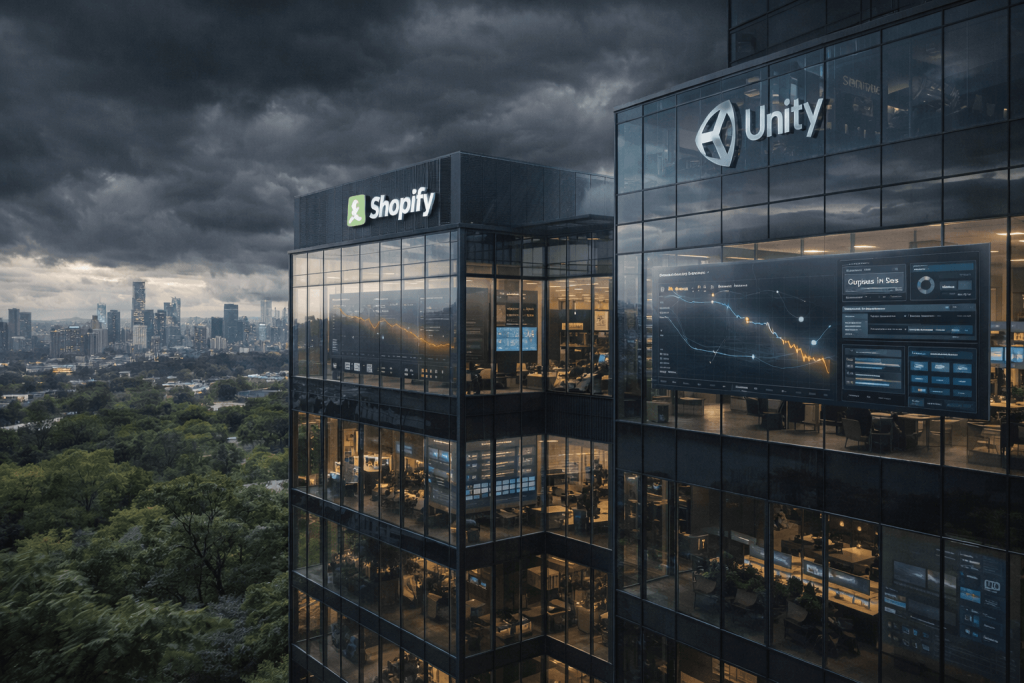
Shares of Shopify and Unity fell sharply this week as investors reassessed growth-heavy tech companies amid broader market volatility.
According to a report from The Information, both companies were hit during a wider sell-off driven by concerns over AI spending levels, profitability timelines, and slowing enterprise demand. The decline reflects a broader investor shift away from high-multiple software names toward companies with clearer near-term earnings stability.
What Happened?
E-commerce platform Shopify and game engine maker Unity both saw their stock prices decline as part of a broader tech downturn.
The market reaction appears tied to several converging factors:
- Investor fatigue around high AI infrastructure spending
- Concerns about monetization timelines for AI-driven features
- Slower growth signals across software and digital commerce segments
- Broader macroeconomic uncertainty affecting risk appetite
While neither company announced a dramatic operational change this week, the market response reflects heightened sensitivity toward tech valuations — particularly those tied to long-term AI investment narratives.
Why Shopify Was Targeted
Shopify has positioned itself as an AI-forward commerce platform, rolling out tools such as AI-powered storefront generation, automated product descriptions, and conversational shopping assistants.
However, investors are increasingly asking:
- How quickly can AI tools convert into revenue growth?
- Will merchants pay meaningfully more for AI-driven capabilities?
- Does AI improve gross margin, or increase compute costs?
Shopify remains fundamentally tied to merchant activity and online retail performance. Any slowdown in small business spending or e-commerce growth can amplify volatility in its stock.
The company’s heavy investment in AI features strengthens its long-term competitive positioning — but markets currently appear focused on near-term earnings clarity rather than long-term platform evolution.
Why Unity Is Under Pressure
Unity, best known for its real-time 3D engine used in gaming and simulation, has been navigating a multi-year transition:
- Shifting revenue models
- Repairing developer trust after pricing changes
- Investing in AI-assisted game development tools
Unity has introduced generative AI features aimed at speeding up asset creation and gameplay development. But similar to Shopify, the monetization model for AI-enhanced tools is still evolving.
The market’s anxiety may stem from:
- High R&D spending
- Ongoing restructuring efforts
- Uncertainty about sustainable profitability
Unity’s exposure to gaming cycles and advertising markets also adds variability to its revenue base.
The Bigger Picture: AI Spending vs. AI Returns
The broader tech market is entering a recalibration phase.
Over the past two years, companies across software, commerce, gaming, and enterprise infrastructure accelerated AI investment. That spending includes:
- GPU-heavy cloud infrastructure
- Model licensing costs
- In-house model development
- AI feature integration across product lines
Now, investors are increasingly focused on:
- Return on AI investment
- Margin impact
- Revenue acceleration tied directly to AI
The shift marks a transition from AI enthusiasm to AI accountability.
For publicly traded companies, the question is no longer whether AI matters — but whether it materially improves unit economics.
Industry Perspective
Market analysts have pointed out that volatility in companies like Shopify and Unity reflects broader sentiment, not necessarily company-specific failure.
High-growth tech stocks are particularly sensitive during:
- Interest rate uncertainty
- Earnings season volatility
- Sector-wide repricing events
AI adoption remains a long-term structural trend. However, markets are currently rewarding:
- Predictable cash flow
- Cost discipline
- Clear monetization pathways
Companies that cannot clearly articulate how AI translates into revenue expansion may face short-term pressure.
What’s Next?
Several factors will determine how Shopify and Unity perform in the coming quarters:
- Earnings guidance updates
- AI feature adoption metrics
- Gross margin trends
- Enterprise vs. SMB demand stability
- Broader macroeconomic conditions
If AI investments begin demonstrating measurable revenue lift or margin efficiency, sentiment could shift quickly.
But in the near term, volatility may persist as investors demand clearer proof of AI-driven returns.
Conclusion: A Sentiment Reset, Not a Structural Collapse
The sell-off in Shopify and Unity reflects a market increasingly cautious about AI-related spending and growth valuations.
Neither company appears to be abandoning its AI strategy. Instead, the market is recalibrating expectations — moving from hype-driven multiples toward performance-based scrutiny.
The message from investors is clear: AI ambition must now be matched by financial results.
Key Takeaways
- Shopify and Unity shares declined amid broader tech market volatility.
- Investor concerns center on AI spending levels and monetization timelines.
- Markets are shifting focus from growth narratives to profitability clarity.
- AI remains central to both companies’ strategies, but near-term earnings pressure may continue.
- The broader tech sector is entering a phase of AI performance validation rather than expansion enthusiasm.